Direct answer: For most SaaS companies, Sanity is the strongest default headless CMS — its structured content model and real-time collaboration fit content-heavy, SEO-dependent marketing sites well. Contentful wins when enterprise governance matters more than speed. Strapi wins when a team wants full self-hosted control. Payload CMS is worth watching, but it carries real post-acquisition uncertainty right now.
We’re a Next.js and Sanity migration agency. We won’t pretend to be neutral — but we work with all four of these platforms in production, and we’ll tell you honestly where each one wins and where it doesn’t.
For a broader, non-SaaS-specific comparison of headless platforms, see our full headless CMS guide. This piece is narrower on purpose.
How We Evaluated These Platforms
A generic “best CMS” ranking evaluates tools against a generic website. A SaaS company isn’t a generic website — it usually has a marketing site, docs, and a product, often on three different subdomains with three different editorial owners.
We scored each platform against what actually matters at that scale:
- Content-modeling depth — can it represent docs, in-app copy, and marketing pages without hacks
- Editor experience — can non-engineering teams publish without filing a ticket
- SEO and migration safety — does it support clean metadata, redirects, and structured data out of the box
- Next.js fit — how much custom plumbing does the integration need
- Pricing at 20–100 employee scale — not enterprise pricing, not hobby-project pricing
We’ve shipped 20+ Next.js migrations onto this stack with zero SEO ranking drops. That’s the lens the rest of this article is written through.
Headless CMS for SaaS: Comparison Table
| Platform | Best for | Hosting | Starting price | Learning curve |
|---|---|---|---|---|
| Sanity | Structured content, SEO-heavy SaaS sites | Cloud (managed) | Free (20 seats) / $15 per seat/mo Growth | Medium — GROQ is unique to Sanity |
| Contentful | Enterprise governance, multi-brand | Cloud (managed) | Free (limited) / $300/mo entry paid tier | Medium |
| Strapi | Full self-hosted control | Self-hosted or Strapi Cloud | Free (MIT, self-hosted) / ~$18/mo Cloud | Medium |
| Payload CMS | Next.js-native single-codebase setups | Self-hosted (Cloud paused) | Free (MIT, self-hosted) | Medium |
Sanity: Best Overall for SaaS Companies
Sanity stores content in a “Content Lake” — a hosted database that treats content as structured data rather than static pages. It’s queried through GROQ, Sanity’s own query language, which gives you precise control over exactly what data you fetch.
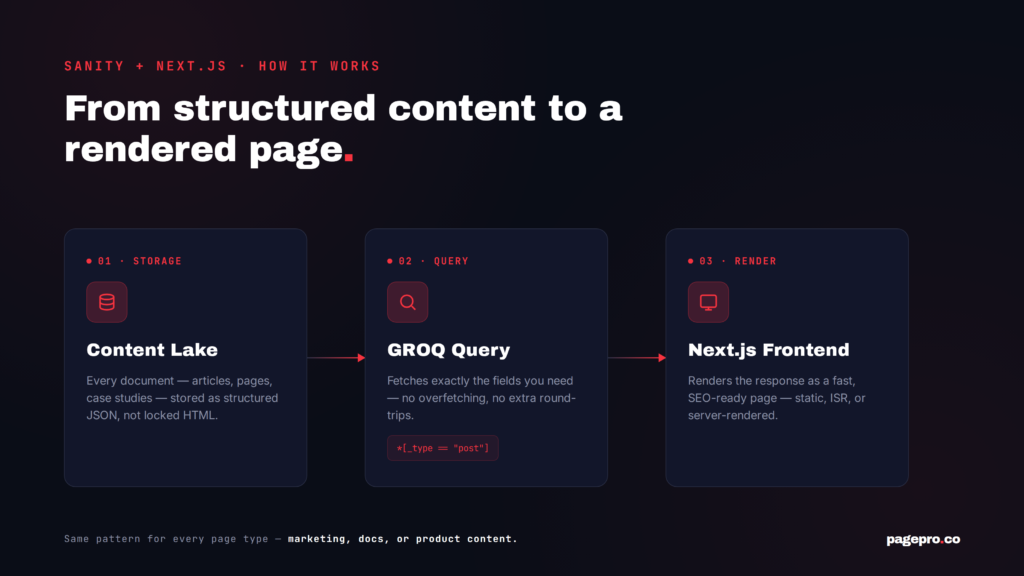
That precision matters for a SaaS marketing site with dozens of page types: feature pages, comparison pages, case studies, pricing variants. You’re not overfetching a bloated REST payload for a simple hero section.
Here’s what a real GROQ query looks like — fetching blog articles filtered by category, something a REST API usually needs multiple round-trips for:
*[_type == "post" && category->slug.current == "product-updates"]
  | order(publishedAt desc)[0...10]{
    title,
    slug,
    "categoryName": category->title,
    publishedAt
  }
Sanity’s Presentation tool adds live, click-to-edit preview — a real gap-closer between developer-owned schemas and marketer-owned content.
Pricing: Free plan includes 20 seats (Administrator and Viewer roles). Growth plan is $15 per seat/month, unlocking Editor, Developer, and Contributor roles, up to 50 seats. There’s no self-hosted option — Sanity’s backend is a managed service by design.
The tradeoff is real: GROQ has a steeper learning curve than a plain REST API, and a very flexible content model can sprawl into unmanaged content types if nobody owns schema discipline.
Contentful: Best for Enterprise Governance
Contentful is the mature, API-first incumbent. It’s usually the safest, least controversial choice when a company already has front-end engineering resources and wants proven multi-environment workflows.
Where it wins for a SaaS company specifically:
- Structured environments and content workflows built for large teams
- A wide integration ecosystem most developers have already touched
- Genuine multi-brand, multi-locale governance at scale
Where it doesn’t: the free tier is limited, and the entry paid tier starts at $300/month — a real jump for a 20–100 employee company compared to Sanity’s per-seat model. It also still needs a well-designed front-end component system before marketing can truly self-serve; the platform alone doesn’t guarantee no-ticket publishing.
Strapi: Best for Full Self-Hosted Control
Strapi is open-source (MIT license) and self-hostable, which makes it the right call for teams that specifically don’t want a SaaS vendor holding their content.
Self-hosted software needs active patching, and that’s not theoretical. In May 2026, Strapi disclosed five vulnerabilities via their own official security blog, including CVE-2026-27886 and CVE-2026-22599 — both rated critical, both patched in v5.37.0. Teams that self-host and delay updates carry that risk directly; a managed platform absorbs it for you.
That’s not a reason to avoid Strapi. It’s a reason to treat “we’ll self-host it” as an ongoing security commitment, not a one-time setup task.
Pricing: Free to self-host (MIT). Strapi Cloud starts around $18/month for smaller teams.
Payload CMS: Worth Watching
Payload runs inside your Next.js application as part of the same codebase — no separate service, no separate deployment. For a team already fully committed to Next.js, that’s a genuinely tight integration.
But there’s a current wrinkle worth taking seriously before betting a multi-year content strategy on it:
- June 17, 2025 — Figma announced it had acquired Payload, bringing the team in-house to build what will likely become a Figma-native CMS product
- Since the acquisition — Payload Cloud (the managed hosting option) paused new signups during the transition
- As of the most recent check — those signups remain paused; the open-source MIT codebase and self-hosting are unaffected, but the managed-hosting roadmap carries real uncertainty
None of that makes Payload a bad technical choice. It does mean a SaaS company evaluating it today should plan to self-host rather than assume managed hosting will be available on your timeline.
For the full technical head-to-head, see our dedicated Payload CMS vs Sanity comparison, based on the same 20+ migrations referenced above.
A Real SaaS Hosting Cost Example
Whichever CMS you choose, it sits on top of a hosting bill — usually Vercel for a Next.js-based SaaS site. That cost is often the bigger line item once you scale past a handful of pages.
We recently optimized Vercel spend for a SaaS platform client (anonymized at their request):
| Metric | Result |
|---|---|
| Monthly Vercel cost | 35% reduction |
| Build time | 40% reduction |
| Traffic capacity at same cost | 1.5x increase |
The fixes were serverless function efficiency, build pipeline streamlining, and incremental static regeneration — none of it CMS-specific, all of it relevant to the total cost of running a content-heavy SaaS site on this stack.
Migrating to a Headless CMS Without Losing SEO
This is the part most CMS comparisons skip, because most of them are written for a greenfield build, not a company replatforming an existing site.
For a SaaS company specifically, this is usually three migrations, not one: the marketing site, the docs, and sometimes the app shell each live on different subdomains with different redirect logic.
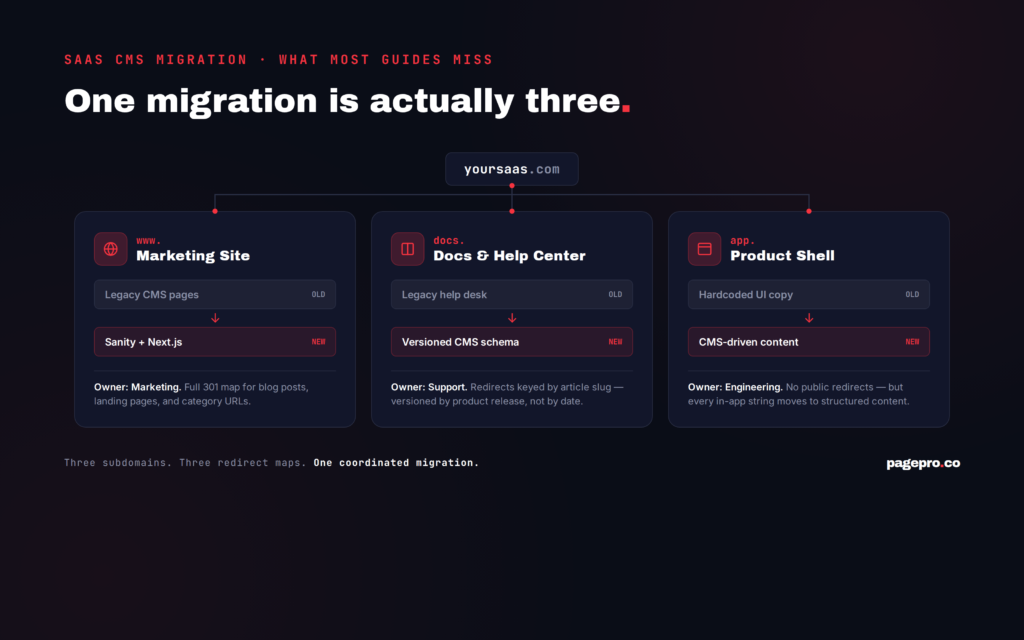
Our full migration-safety framework is covered in SEO Essentials After CMS Migration. The short version, condensed for this context:
- Audit every indexed URL before touching anything — you can’t redirect what you haven’t mapped
- Build a 1:1 redirect map, not a “close enough” one — especially across subdomain boundaries
- Preserve metadata and structured data through the migration, not just the content itself
- Run a content-parity QA pass before DNS cutover, not after
- Monitor indexing and rankings for 4–6 weeks post-launch, not just the first few days
We’ve run this process across 20+ migrations with zero SEO ranking drops. It’s a process problem more than a tooling problem — the CMS you pick matters less than whether the migration plan accounts for all three subdomains.
Which Headless CMS Should You Choose?
| Your situation | Best fit |
|---|---|
| Content-heavy site, SEO is a real growth channel, multiple stakeholders editing | Sanity |
| Enterprise governance, multi-brand or multi-locale requirements already exist | Contentful |
| No budget for per-seat fees, in-house dev capacity to maintain it | Strapi |
| All-in on Next.js, comfortable holding Payload’s transition risk | Payload CMS |
If you’re replatforming an existing SaaS site rather than building greenfield, the migration process matters more than the CMS brand — that’s the conversation worth having first.
FAQ
What is the best headless CMS for a SaaS company in 2026? Sanity is the strongest default for most SaaS companies because of its structured content model, SEO-friendly architecture, and per-seat pricing that scales reasonably for 20–100 employee teams. Contentful, Strapi, and Payload each win in narrower scenarios covered above.
Is Sanity better than Contentful for SaaS? For most SaaS marketing sites, yes — Sanity’s per-seat pricing and structured content model fit better than Contentful’s $300/month entry tier. Contentful pulls ahead when multi-brand governance and existing enterprise workflows are the priority.
Can you migrate an existing SaaS site to a headless CMS without losing SEO rankings? Yes, with a proper redirect map, metadata preservation, and content-parity QA before cutover. We’ve run this process across 20+ migrations with zero ranking drops.
Is Payload CMS still safe to choose after the Figma acquisition? The open-source, self-hosted core is unaffected and still actively maintained. The managed Payload Cloud hosting option has paused new signups since the acquisition, so plan around self-hosting rather than assuming managed hosting availability.
How much does a headless CMS cost for a 20–100 person SaaS company? Sanity’s Growth plan runs $15 per seat/month. Contentful’s entry paid tier starts at $300/month flat. Strapi and Payload are free to self-host, with hosting/maintenance being the real cost instead of a license fee.