TL;DR:
- Headless CMS alternatives to Contentful are content management platforms designed to provide structured content delivery, API-first architecture, and greater architectural control than Contentful.
- In 2026, the leading options — Sanity, Strapi, Hygraph, Storyblok, and Contentstack — differ in structure, offering combinations of structured content modeling, API-first or GraphQL-native architecture, open-source control, visual editing workflows, and enterprise-grade role-based governance.
- The selection process typically follows four evaluation stages: defining business and scalability requirements, assessing content modeling flexibility and API architecture, analyzing governance and localization capabilities, and validating long-term infrastructure viability.
- Their primary applications include supporting composable architecture, enabling structured content reuse across channels, improving developer experience, and ensuring enterprise-grade workflow control.
- These platforms impact the entire digital product lifecycle — from backend schema design and content operations to frontend delivery, performance optimization, and multi-region expansion.
- Key challenges include API usage limits, DevOps complexity, vendor lock-in risk, compliance requirements, and cost scalability at enterprise volume.

Intro
As digital products develop and grow, many businesses start to reevaluate whether Contentful still fits into their business and technical roadmap. Teams are often driven to search for more adaptable headless CMS platforms because of their pricing structures, API usage limits, governance complexity, and vendor lock-in issues.
The best headless CMS platforms that are great alternatives for Contentful are defined in this guide according to:
- Scalability
- Developer experience
- Content modeling flexibility
- Enterprise readiness
- Pricing transparency
- Real-world implementation viability
This guide is based on real-world experience rather than theory because Pagepro has implemented and migrated numerous headless architectures across startups and enterprises.
Book a free consultation to assess your stack and roadmap
What are the best Contentful alternatives in 2026?
The best Contentful alternatives in 2026 are:
- Sanity – best structured content flexibility
- Strapi – best open-source alternative
- Hygraph – best for GraphQL-native projects
- Storyblok – best visual editing experience
- Contentstack – best enterprise governance
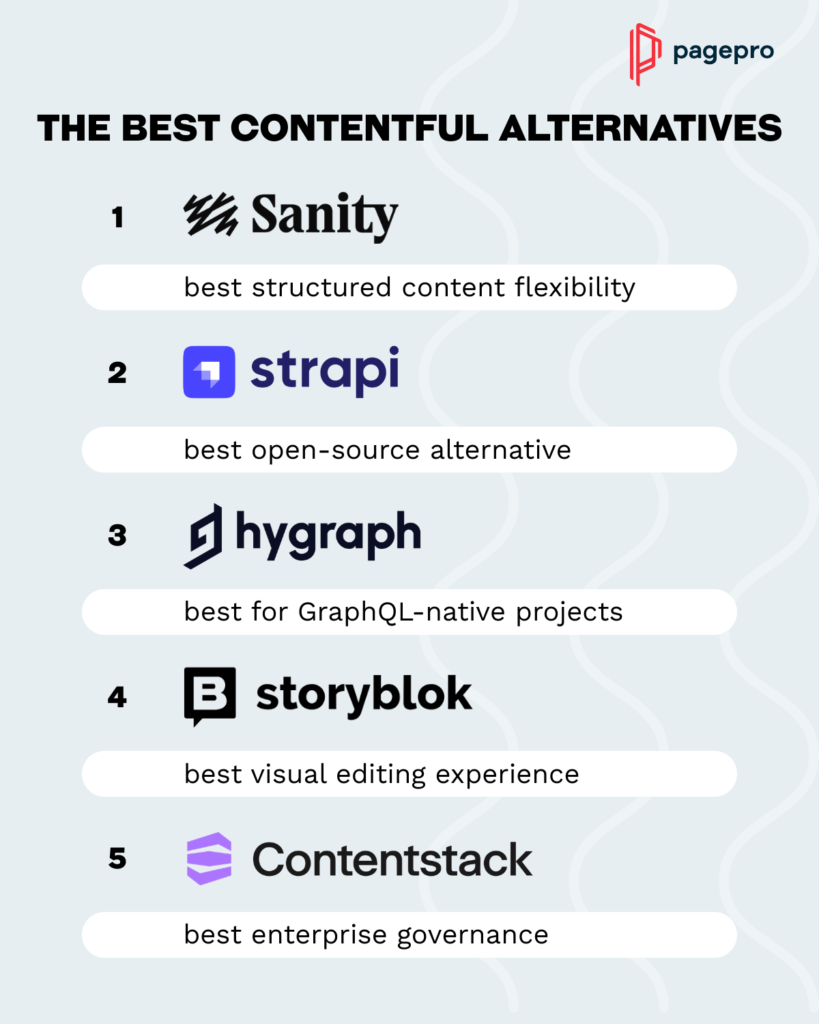
Each of these headless CMS alternatives addresses specific flaws of Contentful, ranging from customization to scalability to editorial workflows.
Let’s analyze them.
Why Companies Look for Contentful Alternatives
Let’s look at the main factors that motivate organizations to look for Contentful alternatives.
1. Pricing & scaling costs
The pricing structure of Contentful may become costly as:
- API calls increase
- Content entries scale
- Locales multiply
- Teams expand
Companies often explore other headless CMS alternatives to find more predictable or infrastructure-controlled pricing models.
2. Vendor lock-In
In the long run, fully SaaS solutions may reduce flexibility. Companies frequently choose:
- Open-source solutions
- Self-hosted infrastructure
- Full backend ownership
3. Customization & developer experience
Modern product teams expect:
- Flexible schema design
- Real-time collaboration
- API-first architecture
- Composable system compatibility
Compared to Contentful, some headless CMS examples offer noticeably more control.
4. Enterprise governance & localization
Large organizations require:
- Advanced role-based permissions
- Multi-region governance
- Compliance-ready infrastructure
- Complex localization workflows
Certain headless CMS platforms focusing on enterprises perform better than Contentful in terms of workflow control and governance.
Top 5 Headless CMS Alternatives to Contentful in 2026
1. Sanity – Most flexible platform for structured content

Overview: Sanity is a headless CMS platform that prioritizes developers and is highly customizable for large-scale structured content.
Why it’s a strong Contentful alternative: fully customizable content studio, real-time collaboration. highly flexible schema design, structured content architecture, API-first foundation.
Sanity offers exceptional flexibility and content modeling freedom among modern Contentful alternatives.
Best for: complex digital products, content-heavy platforms, design-driven ecosystems, teams requiring structured data control.
Pros: deep customization, real-time collaboration, strong developer tooling.
Cons: requires technical setup, learning curve for non-technical teams.
2. Strapi – Best open-source alternative to Contentful

Overview: With complete backend control, Strapi is one of the most widely used open-source headless CMS platforms.
Why it’s a strong Contentful alternative: open-source core, self-hosted or cloud options, custom API logic, plugin ecosystem, no vendor lock-in.
Strapi is among the best headless CMS alternatives on the market if cost flexibility and infrastructure control are important factors.
Best for: startups, dev-driven companies, platforms needing infrastructure ownership.
Pros: full control, flexible architecture, customizable workflows.
Cons: requires DevOps capabilities, more setup effort than pure SaaS.
3. Hygraph – Best for GraphQL-native projects
Overview: Hygraph is a GraphQL-native headless CMS platform that was created for composable architectures.
Why it’s a strong Contentful alternative: GraphQL-first architecture, content federation, API-first approach, structured schema management.
Hygraph can be a more advanced alternative to Contentful for composable digital ecosystems.
Best for: API-driven platforms, composable architecture projects, multi-source content environments.
Pros: strong GraphQL support, scalable structured content, high performance.
Cons: SaaS pricing, advanced tiers required for enterprise features.
4. Storyblok – Best visual editing experience

Overview: Storyblok mixes API-first architecture with an intuitive visual editing interface.
Why it’s a strong Contentful alternative: visual content editor, component-based architecture, strong localization support, enterprise workflows.
For teams focused on marketing, Storyblok is often easier to use than Contentful.
Best for: marketing-led organizations, multi-language websites, editorial-heavy platforms.
Pros: user-friendly interface, flexible content components, scalable infrastructure.
Cons: less backend control than open-source solutions.
5. Contentstack – Enterprise-grade alternative

Overview: Contentstack is a headless CMS platform focused on enterprise and built for global digital operations.
Why it’s a strong Contentful alternative: advanced governance, enterprise security compliance, localization at scale, role-based workflows.
Contentstack is a solid enterprise option for businesses searching for the best headless CMS platforms.
Best for: large enterprises, regulated industries, multi-brand ecosystems.
Pros: enterprise security, governance controls, global scalability.
Cons: premium pricing, complex for smaller teams.
Contentful vs Top headless CMS alternatives – comparison
| CMS | Open source | Best for | Visual editor | Enterprise ready | Flexibility | Pricing |
|---|---|---|---|---|---|---|
| Sanity | No | Structured content | Customizable | High | Very high | – Free plan up to 20 users – Growth starts ~$15/user/month – Enterprise custom pricing |
| Strapi | Yes | Dev teams | No | Medium | Very high | – Free Community plan – Growth starts ~$45/month – Enterprise custom pricing |
| Hygraph | No | GraphQL projects | Limited | High | High | – Free Hobby plan – Growth starts ~$199/month – Enterprise custom pricing |
| Storyblok | No | Marketing teams | Yes | High | Medium | – Free Starter plan – Growth starts ~$99/month – Growth Plus starts ~$349/month – Enterprise custom pricing |
| Contentstack | No | Enterprise | Yes | Very High | Medium | – Custom pricing |
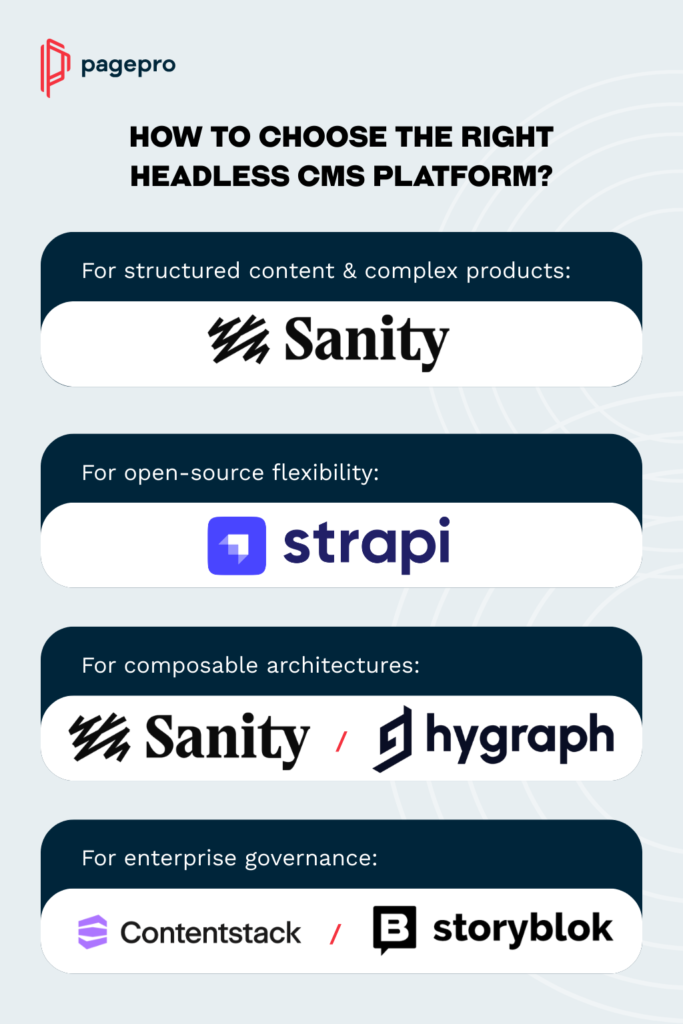
How to choose the right headless CMS platform
How to choose the right headless CMS platform
There’s no universal best solution. The right pick depends on which Contentful pain point is actually costing you the most.
| Your Primary Pain Point | Pick | Why |
|---|---|---|
| Pricing & scaling costs | Strapi (if you can self-host) or Sanity | Strapi has the lowest cost floor with in-house engineering. Sanity’s seat-based pricing doesn’t spike with traffic the way Contentful’s API metering does. |
| Developer experience & customization | Sanity, or Hygraph if GraphQL-native | Sanity gives the most control via schema-as-code. Hygraph removes the REST-to-GraphQL translation layer if that’s already your stack. |
| Marketing team autonomy | Storyblok | Visual editor built for marketers to publish without engineering in the loop — the direct fix if “my content team can’t ship” is the actual complaint. |
| Enterprise governance & localization | Contentstack, or Storyblok if you also need marketer-friendly editing | Contentstack matches Contentful’s role-based permissions and compliance depth with fewer pricing surprises. |
| Not sure which one is primary | — | Check which cost is growing fastest month over month — engineering hours, marketing bottlenecks, or API bills. That’s your real constraint, whether or not it’s what triggered the search. |
Your CMS decision should support long-term scalability — not just short-term convenience.
Still not sure which headless CMS to choose?
FAQ
The top 5 headless CMS platforms in 2026 are Sanity, Strapi, Hygraph, Storyblok, and Contentstack. Because they provide more flexibility, structured content modeling, open-source options, visual editing capabilities, or enterprise-grade governance based on business needs, these platforms are seen as strong alternatives to Contentful.
The easiest CMS to use depends on the team. Sanity offers developers organized workflows and simple schema customization. Storyblok, because of its visual editor, is often considered as the most user-friendly tool for marketing teams. Ease of use ultimately depends on your team’s priorities.
Key CMS trends in 2026 include:
– Composable architecture adoption
– Structured content modeling
– API-first and GraphQL-native systems
– Greater demand for open-source control
– AI-assisted content workflows
– Multi-region localization at scale
These days, headless CMS platforms are moving toward ecosystems that prioritize integration, scalability, and flexibility.
Popularity varies by segment. Sanity and Storyblok are rapidly growing in enterprise and product-focused environments. Strapi is widely used because of its open-source model. While Contentful remains well-known, many companies are actively exploring headless CMS alternatives to get greater flexibility and cost control.
There is no universal best headless CMS.
– Sanity is best for structured content and flexibility.
– Strapi is best for open-source control.
– Hygraph is ideal for GraphQL-native architectures.
– Storyblok excels in visual editing.
– Contentstack is strongest for enterprise governance.
The best choice depends on your scalability goals, technical capabilities, and long-term architecture strategy.
Final Thoughts
In 2026, the headless CMS market is more developed than it has ever been. The best headless CMS platforms available today have better governance capabilities, better scalability, and an enhanced developer experience compared to earlier iterations.
Considering these alternatives could provide greater flexibility, cost effectiveness, and architectural control if Contentful is no longer in line with your roadmap.
The CMS that best suits your product vision and long-term growth shouldn’t always be the most popular one.