Best CMS Development Companies in 2026: An Expert Guide for Tech-Aware Teams

TL;DR
- CMS development covers the full lifecycle of building, configuring, and maintaining a content management system, while CMS migration is a higher-risk subset requiring a specialist methodology and defined process.
- A traditional CMS like WordPress couples content management to the presentation layer, while a headless CMS delivers content via API to any frontend — making headless the stronger choice for teams with multiple channels or performance constraints.
- The right agency depends on stack alignment, not just budget — a WordPress specialist and a Next.js + Sanity migration specialist are solving fundamentally different problems and should not be evaluated on the same criteria.
- Pricing model is a more important variable than hourly rate — fixed-price engagements transfer scope risk to the agency, while hourly engagements transfer it to the client, and total hours to delivery determines actual cost.
- CMS platform subscription costs, hosting, integrations, and internal team time are frequently underestimated — total cost of ownership over three years is consistently higher than the agency delivery fee alone.
- Choosing a CMS partner requires clarity on three things before any proposal: the primary pain driving the project, the target stack in 12 months, and the organisation’s tolerance for scope risk.
- Pagepro delivers Next.js and Sanity migrations using Nexity — a proprietary framework built from 20+ real client projects. The result: around 30% faster delivery than agencies building from scratch, zero SEO ranking drops across all migrations on record, and a 9.7 out of 10 average client satisfaction score. See how Nexity works →
What Is CMS Development? (And Why the Definition Matters in 2026)
CMS development is the process of building, configuring, migrating, or modernising the system that manages and delivers your web content. That definition sounds simple. In practice, it covers everything from installing and customising a WordPress theme to architecting a fully decoupled headless CMS that feeds content to a Next.js frontend via API.
The distinction matters because “CMS development” means something very different depending on where your business is right now. A company maintaining a five-year-old WordPress site needs a different kind of agency than a SaaS company migrating 800 pages of content from a custom monolith to Sanity on Vercel. Hiring the wrong type of specialist for either project is an expensive mistake.
In 2026, that gap has become more urgent. The distance between legacy CMS architectures and modern headless stacks is wider than it has ever been — and more companies are crossing it. Teams that built their web presence on WordPress, Drupal, or stitched-together no-code tools are hitting real performance ceilings: slow Core Web Vitals, editorial teams blocked by developer dependency, SEO plateaus despite consistent content investment. The agencies equipped to solve those problems are not the same agencies that set up the original WordPress install.
How We Selected the Best CMS Development Companies
Choosing a CMS development partner is a high-stakes decision. The wrong agency can cost you months of recovery time, a significant SEO ranking drop, and a codebase you’ll be paying another agency to fix within 18 months. The list below was built to help you avoid that outcome.
We evaluated companies based on five criteria — applied consistently across every entry.
1. Demonstrated Platform Specialisation
Generic “we work with any CMS” agencies were excluded. Every company on this list has a documented, verifiable practice in at least one CMS platform — evidenced by case studies, partner status, or a track record of named project delivery. Platform breadth alone was not rewarded; depth was.
2. Verifiable Project Outcomes
Service descriptions are marketing. What matters is evidence: named clients, measurable results, before/after comparisons. Companies with no publicly verifiable project outcomes scored lower regardless of how polished their website is.
3. Transparent Pricing Model
Hourly rate ranges and minimum project sizes are included where publicly available. We also evaluated whether each agency’s commercial model — fixed-price, hourly, or retainer — is clearly communicated upfront. Opacity around pricing is itself a signal worth noting.
4. Migration Methodology
For any agency positioned around CMS migration, we looked for evidence of a defined process — not just “we’ve done migrations before.” Discovery, content audit, redirect mapping, SEO preservation, and post-launch monitoring are the minimum components of a credible migration practice.
5. Post-Migration Support Capability
A migration that ends at handover is an incomplete service. We favoured agencies that offer structured SLA or retainer arrangements after project delivery — because the weeks immediately following a migration are when most issues surface.
One editorial note: Pagepro is included on this list and placed first by specialisation fit for the specific ICP this article addresses — Digital Native SMBs migrating to Next.js and Sanity. We are the authors. That conflict is worth naming directly. The other nine companies were evaluated using the same criteria, using publicly available information, Clutch reviews, platform partner directories, and published case studies.
The 10 Best CMS Development Companies in 2026
The agencies below represent a range of specialisations, pricing models, and technical approaches. Each profile follows the same structure: what they do, who they serve best, and what sets them apart — based on publicly available information, verified client reviews, and published case studies.
1. Pagepro — Next.js & Sanity Migration Specialists
Pagepro is a specialist development agency focused exclusively on migrating legacy and underperforming web stacks to Next.js and Sanity on Vercel. Unlike generalist CMS agencies, Pagepro operates a fixed-price migration model built around Nexity — a proprietary migration framework developed across 20+ real client projects.

The core differentiator is demo-first selling: before any scope is agreed, Pagepro rebuilds a section of the prospect’s site using their actual content within 48 hours. This removes buying uncertainty in a way no proposal document can replicate.
- Tech stack: Next.js, Sanity, Vercel, TypeScript, TurboRepo
- Pricing model: Fixed-price (post-assessment) + monthly SLA retainer
- Minimum project: From $15,000 (takeover audit) / from $30,000 (full migration with content)
- Best for: Digital Native SMBs (20–100 employees, UK & US) migrating from WordPress, custom monoliths, or no/low-code stacks to a modern headless architecture
- Notable outcome: 20+ migrations delivered with zero SEO ranking drops across all projects. Average client satisfaction score of 9.7 out of 10, measured quarterly.
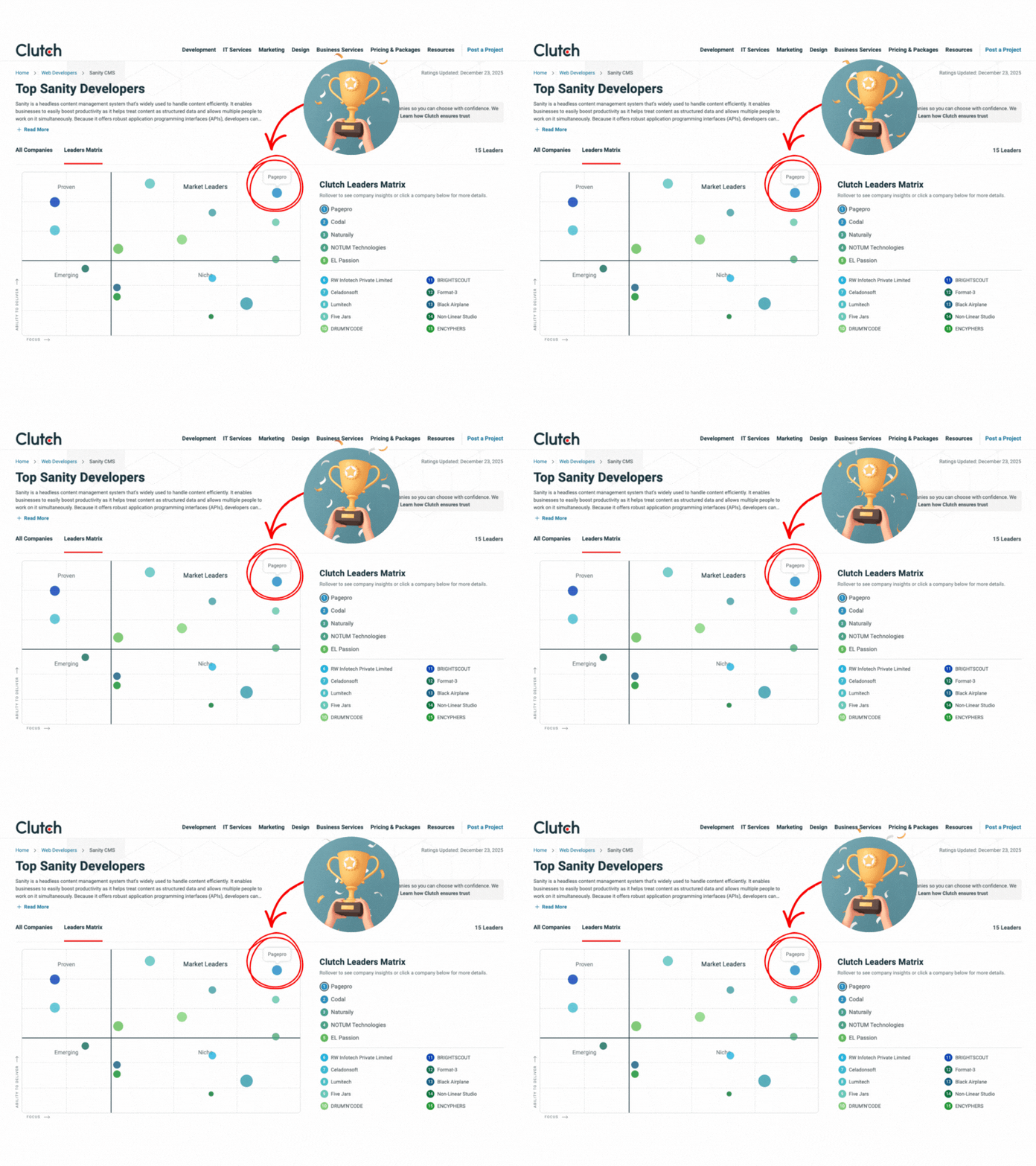
How Pagepro Delivers Next.js & Sanity Migrations: Nexity
Pagepro’s migrations run on Nexity — a proprietary delivery framework built from patterns learned across 20+ real client projects. Rather than starting every engagement from scratch, Nexity provides a production-grade Next.js and Sanity foundation that covers architecture, SEO setup, content blocks, redirect management, and editorial configuration out of the box.
For clients this translates to three concrete outcomes: around 30% faster delivery compared to agencies building from scratch, zero SEO ranking drops across all migrations on record, and a Sanity Studio that editorial teams can actually use from day one — not one that requires six weeks of post-launch refinement.
2. Roboto Studio — Enterprise Next.js & Sanity Specialists

Roboto Studio is a London-based agency that builds exclusively in Next.js and Sanity — no exceptions. That single-stack focus has made them one of the most technically credible agencies in the Sanity ecosystem, with a strong body of work spanning enterprise editorial platforms, composable commerce, and high-traffic content sites.
Their proprietary starter, Turbo Start Sanity, is the open-source foundation they use across client projects — an approach similar to Pagepro’s Nexity, though positioned primarily at larger organisations rather than Digital Native SMBs. Notable delivered projects include migrating Teckro’s website to Sanity v3 in eight weeks, reducing Bulletproof’s build times from 30 to 4 minutes after switching to Vercel, and improving Trippin World’s build time by 90%.
Where Roboto Studio differs from Pagepro is scale and commercial model. Their work skews toward FTSE 500 clients and larger enterprise engagements. They do not publish fixed pricing — projects are scoped individually at hourly rates.
- Tech stack: Next.js, Sanity, Vercel, Shopify, Mux
- Pricing model: Hourly (rates not publicly disclosed) + project-based
- Minimum project: £15,000+
- Best for: Enterprise and mid-market teams with complex editorial requirements, composable commerce setups, or high-traffic platforms where Next.js and Sanity are already the chosen stack
- Notable outcome: Migrated Teckro to Sanity v3 in eight weeks; reduced client build times from 30 to 4 minutes post-Vercel migration
3. Netguru — Headless CMS & Product Development for Scale-Ups

Netguru is a Poland-based agency of 300+ people serving product-led companies globally. While not a CMS-only specialist, their headless CMS practice is substantial — with documented work across Contentful, Strapi, Storyblok, and Magnolia for clients including Puma and Worldpay. They are a Vercel partner and operate at a scale that allows them to staff complex, multi-team projects without quality dilution.
Where Netguru differs from the specialists above is breadth. They are a full-service digital product agency — UX, design, backend, mobile, and CMS all sit within the same practice. For companies that need a single partner to handle an end-to-end digital transformation, that breadth is an asset. For companies that specifically need deep Next.js and Sanity migration expertise, it is less relevant — CMS is one service line among many, not a core identity.
They were recognised as Clutch’s Top B2B Technology Services Provider in 2025, with consistently strong client reviews highlighting project management, UX process, and the ability to scale teams quickly.
- Tech stack: Contentful, Strapi, Storyblok, Magnolia, React, Next.js, Ruby on Rails
- Pricing model: Hourly ($50–$99/hr) + dedicated team models
- Minimum project: $50,000+
- Best for: Scale-ups and product-led companies needing headless CMS as part of a broader digital product build — fintech, ecommerce, SaaS
- Notable outcome: Delivered Next.js and headless CMS implementations for Puma and Worldpay; recognised as Clutch Top B2B Technology Services Provider 2025
4. Codal — Full-Service Digital Transformation with CMS Expertise
Codal is a Chicago-based award-winning design and development consultancy with over 15 years of experience delivering complex digital products for enterprise and mid-market clients. Their approach is full-service by design — product strategy, UX, engineering, and CMS all delivered by a single team — which makes them particularly strong when a CMS migration sits inside a broader digital transformation, not as a standalone project.
Their technical background in custom software development before shifting to commerce and CMS work means they are unusually capable with complex API integrations — a meaningful differentiator for enterprises connecting a CMS to CRM, ERP, or third-party data systems. Notable delivered projects include rebuilding a HIPAA-compliant patient platform for Mark Cuban’s Cost Plus Drug Company, delivered on time with minimal disruption, and building a global logistics management application for Flexport by integrating complex APIs across multiple systems.
They hold Shopify Platinum partner status and have been named BigCommerce Agency of the Year twice. CMS work sits within a broader commerce and product practice rather than as a standalone specialism.
- Tech stack: Contentful, Sanity, Shopify Plus, React, Next.js, AWS
- Pricing model: Hourly ($150–$199/hr) + fixed-scope engagements
- Minimum project: $75,000+
- Best for: Mid-to-large enterprises needing CMS as part of a broader digital transformation — particularly strong for complex API integrations, commerce-connected CMS, and organisations with significant design and product strategy requirements alongside engineering
- Notable outcome: Rebuilt HIPAA-compliant patient platform for Mark Cuban’s Cost Plus Drug Company on time with minimal account disruption; global logistics app delivered for Flexport integrating complex multi-system APIs
5. Iflexion — Enterprise CMS with Deep Integration Expertise

Iflexion is one of the most experienced CMS development companies on this list — founded in 1999, with 25 years of delivery across web platforms, enterprise CMS, document management systems, and legacy modernisation. Their 850-person team has worked with clients including PayPal, Expedia, Adidas, Google, and the World Health Organization, which demonstrates the ability to operate within large enterprise governance structures and complex procurement requirements.
Their CMS practice centres on WordPress, Drupal, Sitecore, and headless architectures, with a particular strength in API-driven integrations — connecting CMS platforms to CRM, ERP, HR tools, and third-party SaaS systems. For organisations that need a CMS to function as a node in a broader connected digital ecosystem rather than a standalone publishing tool, that integration depth is genuinely valuable.
One consistent pattern across Clutch reviews is their communication discipline during delivery — clients describe regular status updates, Jira-level ticket visibility, and project managers who surface risks proactively. Clutch-reported project costs range from $7,000 to $1 million, confirming a delivery model that scales across project sizes.
- Tech stack: WordPress, Drupal, Sitecore, Headless CMS, .NET, Java, Python
- Pricing model: Hourly ($25–$49/hr)
- Minimum project: $10,000+
- Best for: Enterprises and mid-market businesses with complex CMS integration requirements — particularly when the CMS needs to connect with CRM, ERP, or compliance-regulated data systems
- Notable outcome: Delivered CMS projects for PayPal, Expedia, Adidas, and the World Health Organization across 30+ countries
6. ELEKS — Enterprise CMS for Regulated and Complex Industries

ELEKS is a global software engineering company with 2,000+ specialists, 30+ years of delivery experience, and a client base that spans healthcare, finance, energy, logistics, and government. Over 90% of their business comes from repeat engagements — a retention figure that speaks directly to delivery quality and long-term partnership reliability.
Their CMS work sits within a broader enterprise software practice, which means they are best suited to organisations where CMS development is embedded in a larger digital transformation — platform migrations, multi-site consolidations, and content systems that need to integrate with complex enterprise data environments. A notable delivered project is the migration of Imerys from 60+ siloed websites to one harmonised digital ecosystem — a scale and complexity of CMS consolidation that few agencies on this list could credibly handle.
What distinguishes ELEKS in the regulated sector is their compliance infrastructure: ISO 9001, ISO 27001, SOC 2 Type II, HITRUST e1, and Cyber Essentials Plus certifications. For healthcare, finance, and government buyers where vendor compliance is a procurement requirement, not just a preference, this matters more than any feature comparison.
- Tech stack: Custom CMS, WordPress, headless architectures, .NET, JavaScript, AI integrations
- Pricing model: Hourly ($50–$99/hr) + dedicated team models
- Minimum project: $25,000+
- Best for: Enterprises in regulated industries — healthcare, finance, energy, logistics, government — where CMS development requires compliance certifications, multi-site consolidation, or deep integration with enterprise systems
- Notable outcome: Migrated Imerys from 60+ siloed websites to one harmonised digital ecosystem; customs processing system for Jersey government scaled from 200 to 10,000+ consignments per week
7. Intellectsoft — Digital Transformation for Enterprise and Growth-Stage Businesses

Intellectsoft is a digital transformation consultancy founded in 2007, delivering custom software, CMS implementations, and system integrations for enterprise and growth-stage clients globally. Their work spans finance, healthcare, retail, automotive, and logistics, with named clients including Fitbit, HSBC, Cisco, Eurostar, EY, and Guinness.
Their CMS practice sits within a full-service digital transformation offering — alongside mobile development, IoT engineering, AI applications, and enterprise systems integration. This breadth makes them a credible option for growth-stage businesses that need a single partner to handle multiple workstreams simultaneously, but it also means CMS is one capability among many rather than a primary specialisation.
Clutch reviewers consistently highlight Intellectsoft’s project management quality — proactive communication, clear deadline management, and responsiveness — which is a meaningful differentiator for enterprise buyers managing complex internal stakeholder environments alongside an external delivery partner.
- Tech stack: WordPress, Drupal, headless CMS, Java, Swift, JavaScript, React Native
- Pricing model: Hourly ($50–$99/hr)
- Minimum project: $50,000+
- Best for: Enterprise and growth-stage businesses needing CMS as part of a broader digital transformation — particularly strong for multi-workstream projects combining CMS with mobile, AI, or IoT
- Notable outcome: Enterprise software and CMS delivery for Fitbit, HSBC, Cisco, Eurostar, EY, and Guinness across finance, healthcare, and retail sectors
8. BairesDev — Nearshore Scale for CMS Teams That Need to Move Fast

BairesDev is a US-headquartered nearshore development firm with 4,000+ engineers across Latin America, operating in the same timezone as North American clients. Founded in 2009, they have completed 1,250+ projects with a 4.9 Clutch score and a 91% customer satisfaction rate. In 2025 they were recognised as Top 100 U.S. IT Innovators by CIO100 Awards and Nearshore North America Top Software Developers by Clutch.
Their CMS practice covers WordPress, Drupal, Contentful, Strapi, and custom CMS platforms — with the stated ability to staff a dedicated CMS team within 2–4 weeks. That speed of team assembly is their primary differentiator. For companies facing a tight timeline on a CMS project and needing to scale quickly without the overhead of a permanent hire, BairesDev removes that constraint faster than most alternatives.
The honest trade-off: BairesDev is a staffing-and-delivery model, not a specialised CMS agency. They bring scale and speed; they do not bring a proprietary migration methodology, a fixed-price model, or deep platform-specific IP. Projects typically start around $75,000 and scale quickly for multi-phase engagements.
- Tech stack: WordPress, Drupal, Contentful, Strapi, custom CMS, React, .NET
- Pricing model: Hourly ($50–$99/hr) + dedicated team models
- Minimum project: $50,000+
- Best for: Companies needing to staff a CMS development team quickly — particularly US-based organisations that require timezone alignment, English-language communication, and the ability to scale team size up or down across project phases
- Notable outcome: 1,250+ projects delivered since 2009; 4.9 Clutch score across 73 verified reviews; average client relationship of over 3 years
9. SmartSites — WordPress & HubSpot CMS for SMBs Combining CMS with Marketing

SmartSites is a New Jersey-based full-service digital marketing agency founded in 2011, recognised as a nine-time Inc. 5000 fastest-growing company from 2017 to 2025. With over 1,000 five-star reviews online, a 4.9 Clutch score from 354 verified reviews, and Google Premier Partner status, they are one of the most reviewed agencies on this list — a meaningful trust signal for SMBs that rely on peer validation before committing to an agency relationship.
Their CMS practice centres on WordPress and HubSpot, combined with SEO, PPC, and conversion-rate optimisation in a single service model. This integrated approach is their clearest differentiator: where most CMS agencies hand over a built site and step back, SmartSites stays involved as a performance partner — managing ongoing SEO, paid media, and content alongside the CMS itself.
Verified client outcomes include doubling Shopify website sales year-on-year for an air conditioning distributor, cutting Google Ads CPC from $10 to under $3 within the first two days, and achieving ROAS above 10 for a supplements retailer. Their sweet spot is SMBs that want CMS development and digital marketing from one team, not two.
- Tech stack: WordPress, HubSpot CMS, Shopify, Joomla, Magento
- Pricing model: Hourly ($100–$149/hr) + retainer-based marketing packages
- Minimum project: $1,000+
- Best for: Small to mid-sized businesses that need WordPress or HubSpot CMS development combined with ongoing SEO, PPC, and digital marketing support — lowest minimum project size on this list
- Notable outcome: Nine-time Inc. 5000 fastest-growing company 2017–2025; 4.9 Clutch score from 354 verified reviews; doubled client website sales year-on-year across multiple accounts
10. DockYard — Elixir & Phoenix Specialists for High-Performance CMS Builds

DockYard is a US-based digital product consultancy and the world’s preeminent Elixir and Phoenix engineering agency. Their stack is intentionally narrow — they build almost exclusively in Elixir and Phoenix, and they have developed Beacon, an open-source CMS built natively on Phoenix LiveView. Clients include Apple, Netflix, Fidelity Investments, McGraw-Hill, and Zipcar.
Their CMS work is inseparable from their Elixir expertise. For engineering teams already building on Elixir or Phoenix, DockYard is the natural choice — they bring a depth of platform knowledge that no generalist agency can replicate, and their Beacon CMS provides a production-grade content management layer built specifically for the Phoenix ecosystem. For teams not already on Elixir, they are not the right fit — and they would tell you that directly.
Clutch reviewers consistently describe DockYard as a strategic partner rather than a vendor — praised for independent working, minimal supervision needed, and the ability to refine product specifications beyond what the client originally brought to the engagement. Notably, one client reported that despite scope changes mid-project, their timeline and budget were not affected.
- Tech stack: Elixir, Phoenix, Phoenix LiveView, Beacon CMS, AWS
- Pricing model: Hourly ($150–$199/hr) + project-based
- Minimum project: $25,000+
- Best for: Engineering teams already working in Elixir or Phoenix who need a CMS layer or content-heavy platform that integrates natively with their existing stack — not suitable for teams on other stacks
- Notable outcome: Long-term partner to Netflix Production Operations since 2016 building web apps that transform how Netflix Originals get produced; rebuilt MBTA train tracking and API system in Elixir improving performance and reliability
Good call. Here’s the section with intro and outro added:
Quick Comparison Table — CMS Development Companies at a Glance
Not every project warrants reading ten full agency profiles. The table below distills the key decision variables — stack, pricing model, minimum project size, and best-fit scenario — into a single scannable reference. Use it as a first-pass filter, then read the full profile for any agency that matches your situation.
| Company | Tech Stack | Pricing Model | Min. Project | Best For | Notable Outcome |
| Pagepro | Next.js, Sanity, Vercel | Fixed-price + SLA retainer | From $15,000 | Digital Native SMBs migrating to Next.js + Sanity | 20+ migrations, 0 SEO drops, AFS 9.7/10 |
| Roboto Studio | Next.js, Sanity, Vercel, Shopify | Hourly + project-based | From £15,000 | Enterprise editorial platforms and composable commerce | Teckro migrated to Sanity v3 in 8 weeks; build times cut from 30 to 4 minutes |
| Netguru | Contentful, Strapi, Storyblok, Next.js | Hourly + dedicated team | $50,000+ | Scale-ups needing headless CMS within a broader product build | CMS implementations for Puma and Worldpay; Clutch Top B2B Provider 2025 |
| Codal | Contentful, Sanity, Shopify Plus, Next.js | Hourly + fixed-scope | $75,000+ | Enterprise digital transformation with complex CMS integrations | HIPAA-compliant platform for Cost Plus Drug Company; Flexport logistics app |
| Iflexion | WordPress, Drupal, Sitecore, headless CMS | Hourly | $10,000+ | Enterprises needing CMS connected to CRM, ERP, or compliance systems | Projects for PayPal, Expedia, Adidas, and WHO across 30+ countries |
| ELEKS | Custom CMS, WordPress, headless, .NET | Hourly + dedicated team | $25,000+ | Regulated industries — healthcare, finance, energy, government | Imerys migrated from 60+ siloed sites; Jersey government customs system scaled 50x |
| Intellectsoft | WordPress, Drupal, headless CMS, React Native | Hourly | $50,000+ | Enterprise and growth-stage businesses combining CMS with mobile or AI | CMS and software delivery for Fitbit, HSBC, Cisco, Eurostar, and Guinness |
| BairesDev | WordPress, Drupal, Contentful, Strapi | Hourly + dedicated team | $50,000+ | US companies needing a CMS team staffed quickly with timezone alignment | 1,250+ projects; 4.9 Clutch score; team staffed within 2–4 weeks |
| SmartSites | WordPress, HubSpot, Shopify, Magento | Hourly + retainer | $1,000+ | SMBs combining CMS development with ongoing SEO and digital marketing | Nine-time Inc. 5000; 4.9 Clutch score from 354 reviews; doubled client sales YoY |
| DockYard | Elixir, Phoenix, Beacon CMS, AWS | Hourly + project-based | $25,000+ | Engineering teams already on Elixir or Phoenix needing a native CMS layer | Netflix Production Operations partner since 2016; MBTA API rebuilt in Elixir |
Two patterns are worth noting before you move on.
First, pricing model matters as much as hourly rate — a fixed-price agency absorbs scope risk; an hourly agency passes it to you.
Second, stack alignment is non-negotiable: hiring a WordPress specialist for a Next.js + Sanity migration, or a Sanity specialist for a Drupal-to-Kentico project, adds risk that no amount of good project management fully offsets.
Match the agency to your actual stack decision, not just your budget.
Fixed-Price vs Hourly CMS Development — Which Model Protects You
The pricing model is one of the most consequential decisions in a CMS agency relationship, and it is almost never discussed explicitly before the proposal stage.
Fixed-price means the agency absorbs scope risk. You agree on deliverables upfront, the price is set, and overruns are the agency’s problem to manage. This works well when the project is well-defined, the agency has a proven delivery methodology for this type of project, and both parties can agree on clear acceptance criteria before any code is written. The risk to you: if discovery is rushed or scope is ambiguous, the agency may deliver what was written rather than what you needed.
Hourly (T&M) means you absorb scope risk. Every change, every iteration, every hour of investigation is billed. This works well for exploratory or evolving projects where requirements will change. The risk: without strong project management and clear milestones, costs can escalate significantly beyond the original estimate.
One comparison that clarifies the decision: a $50/hr agency completing a project in 400 hours costs the same as a $150/hr agency completing it in 133 hours. Specialist agencies with proven frameworks — like Nexity for Next.js + Sanity migrations — consistently deliver faster than generalists building from scratch. Total cost of engagement, not hourly rate, is the correct comparison metric.
Red Flags That Indicate a Bad-Fit CMS Agency
These signals do not guarantee a bad outcome — but each one increases the probability of one:
- No migration methodology documentation. If an agency cannot show you how they approach a migration before you sign, they are building their process on your project.
- No live demo before scoping. Proposals built on assumptions rather than working prototypes produce the most common source of scope disagreements.
- No named case studies. Anonymised client references are a weak credibility signal. An agency with a strong track record should be able to name clients and offer direct references.
- Hourly-only with no scope protection. A T&M-only agency with no milestone structure or change request process is a budget risk on any project over $25,000.
- No mention of SEO preservation process. Any agency migrating a content-heavy site without a documented redirect and metadata strategy is treating your SEO equity as acceptable collateral damage.
- No post-migration support offer. Handover without a defined support window is an incomplete service — regardless of how well the migration itself was delivered.
Which CMS Stack Is Right for Your Project in 2026?
Choosing an agency and choosing a CMS stack are two separate decisions — but they are deeply connected. The agency you hire should be capable of recommending a stack based on your situation, not defaulting to the one they know best. This section gives you the framework to evaluate that recommendation independently.
The headless CMS software market reached an estimated $3.94 billion in 2025 and is projected to grow to $22.28 billion by 2034, according to Market Research Future — a 21% annual growth rate that reflects genuine enterprise adoption, not hype. Gartner projects that 70% of organisations will be required to adopt composable DXP technology by 2026, up from 50% in 2023. What was an architectural preference three years ago has become infrastructure policy.
That context matters when evaluating your options. The question is not whether headless CMS is the right direction — for most content-heavy Digital Native SMBs, it is. The question is which architecture, and when.
Traditional CMS vs Headless CMS — When Does It Matter?
A traditional CMS — WordPress, Drupal, Joomla — couples the content management interface directly to the presentation layer. The CMS controls both what content looks like and how it is delivered. This architecture works well for straightforward websites with a single delivery channel and a content team that does not need to publish across multiple platforms simultaneously.
A headless CMS — Sanity, Contentful, Storyblok, Strapi — decouples content management from presentation entirely. Content is stored as structured data and delivered via API to any frontend: a Next.js website, a mobile app, a digital kiosk, or an AI assistant. Editors work in a clean interface focused on content, not layout. Developers build the presentation layer independently using whatever framework best fits the project.
The switch to headless makes business sense when three conditions are true: your content needs to reach more than one channel, your editorial team is blocked by developer dependency on a coupled CMS, or your site’s performance is being constrained by the rendering architecture of your current platform.
CMS Stack Comparison — Next.js + Sanity, WordPress, Contentful, Storyblok, Strapi
No single CMS is right for every project. Here is an honest comparison of the five most relevant options for Digital Native SMBs in 2026:
| CMS | Architecture | Best for | Editorial experience | Migration complexity | Hosting |
| Next.js + Sanity | Headless, API-first | Content-heavy sites needing performance, SEO, and editorial velocity | Excellent — customisable Studio, live preview, AI assist | Moderate — requires content modeling and redirect planning | Vercel (recommended) |
| WordPress | Traditional (coupled) | Sites where ecosystem size and plugin availability are priorities | Good for simple use cases; complex for structured content | Low — large migration tooling ecosystem | Any hosting provider |
| Contentful | Headless, API-first | Enterprise teams with complex governance and multi-locale requirements | Good — mature interface, structured workflows | Moderate — strong API but high cost at scale | SaaS (managed) |
| Storyblok | Headless, visual-first | Marketing teams needing visual page-building without developer dependency | Excellent for page building — best-in-class visual editor | Moderate | SaaS (managed) |
| Strapi | Headless, open-source | Teams needing self-hosted, full data control, no vendor lock-in | Adequate — form-based, no visual editing | Moderate — requires infrastructure management | Self-hosted or Strapi Cloud |
How Much Does CMS Development Cost in 2026?
CMS development costs vary more than most buyers expect — not because agencies price arbitrarily, but because the scope of work varies enormously. A basic WordPress setup, a HubSpot CMS implementation, a headless CMS build from scratch, and an ongoing SLA retainer are all “CMS development.” They have almost nothing else in common.
The ranges below are based on real project delivery data and publicly available agency pricing. They cover agency fees only — CMS platform subscription costs are separate and should be factored into your total cost of ownership.
| Project Type | Typical Range | What Drives Cost |
| CMS audit or takeover | $5,000–$15,000 | Codebase complexity, issue severity |
| New CMS build (small site, under 50 pages) | $10,000–$30,000 | Platform choice, design complexity, integrations |
| CMS build with custom integrations (CRM, ERP) | $30,000–$80,000 | Integration depth, custom workflows, compliance |
| Enterprise CMS implementation | $80,000–$200,000+ | Scale, multi-locale, governance, legacy data |
| Ongoing SLA or dev retainer | $3,000–$15,000/month | Scope, response SLA, feature velocity |
Why Hourly Rate Is the Wrong Metric
The most common mistake buyers make when comparing CMS agencies is leading with hourly rate. It is an intuitive comparison — lower rate means lower cost — but it consistently produces the wrong conclusion.
A $50/hr agency that takes 600 hours to deliver a project costs $30,000. A $150/hr specialist with a proven delivery framework completing the same project in 150 hours costs $22,500 — faster, with less risk, and with a codebase your team can maintain. The variable that matters is not hourly rate. It is total hours to delivery — which is a function of methodology, experience, and how much of the problem the agency has already solved on previous projects.
What to Include in Your Total Cost of Ownership
Agency fees are the most visible line item in a CMS project budget. They are rarely the largest cost over a three-year horizon. A complete calculation should include:
- Agency delivery fees — the project cost
- CMS platform subscription — Sanity Growth at $15/seat/month, Contentful Basic at $300/month, Storyblok Business at $2,099/month
- Hosting costs — Vercel Pro, AWS, or equivalent
- Ongoing maintenance and development — SLA retainer or ad-hoc sprint costs
- Internal team time — review cycles, approvals, and onboarding participation
- Integration and third-party tool costs — CRM connectors, DAM, analytics, search
The platform subscription cost is the one most commonly underestimated at the buying stage. A CMS that looks affordable at $99/month can cost significantly more once you factor in user seats, locales, API call volumes, and staging environments at scale.
Conclusion: Choosing the Right CMS Partner for Your Stage
The agencies on this list are all credible. The question is not which is best in the abstract — it is which is the right fit for your specific situation right now.
Three questions should be answerable before you contact any of them:
- What is the primary pain driving this project? Performance, editorial velocity, maintenance cost, and channel expansion all point toward different agency profiles. Being specific about the pain narrows the shortlist faster than any other filter.
- What does your stack look like in 12 months? The CMS you choose is a five-year architectural decision. The agency you hire should be capable of having an honest conversation about where you are going — not just delivering the immediate project.
- What is your tolerance for scope risk? Fixed-price protects your budget but requires thorough discovery. Hourly offers flexibility but transfers cost risk to you. Know which model fits before the proposal stage.
If you are evaluating a migration to Next.js and Sanity, we can show you what your site looks like on the new stack — built with your actual content — within 48 hours, before you commit to anything.